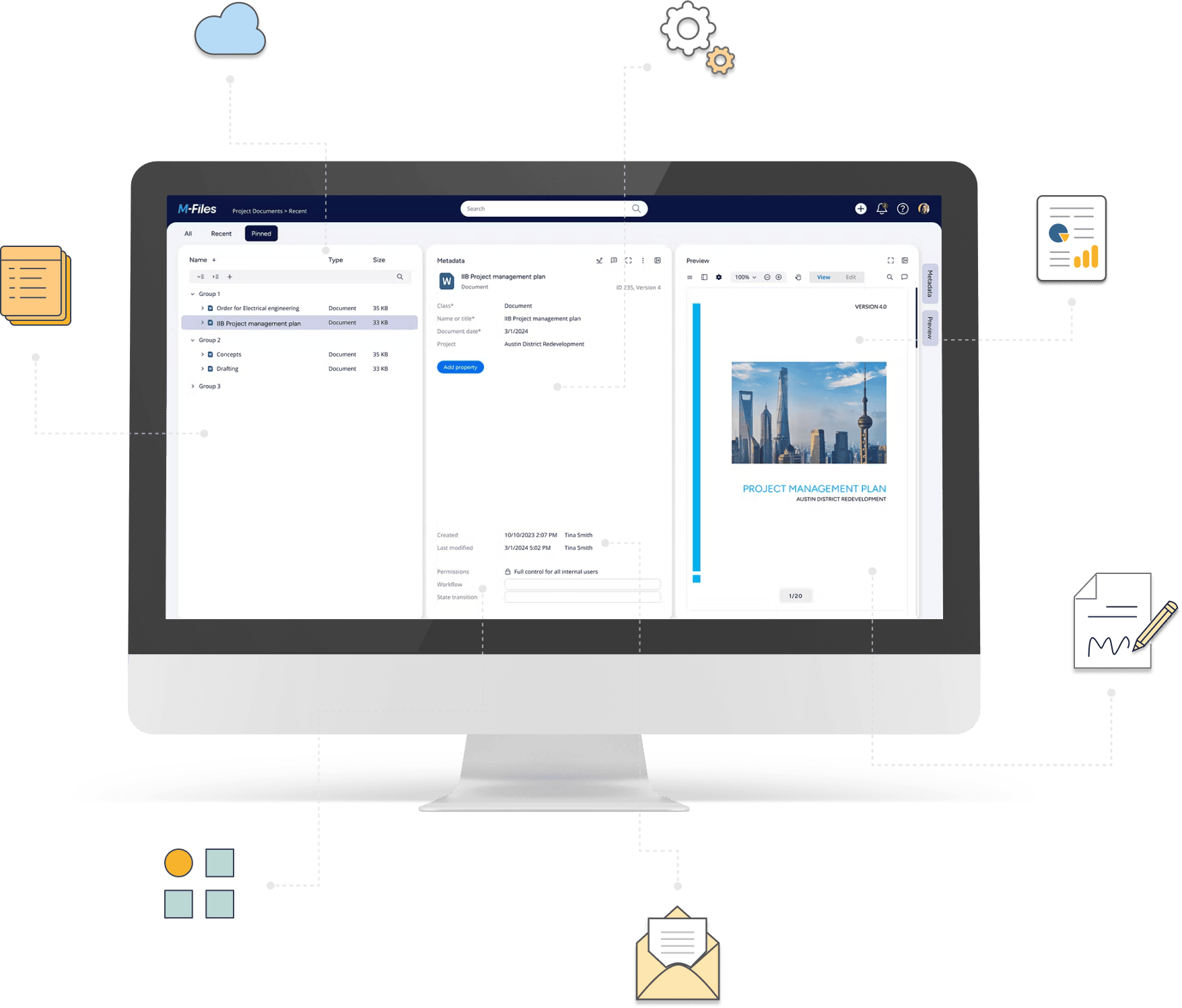
Automate document classification and data extraction in M-Files
Connect M-Files with AI services to classify documents, extract structured information, and apply the results to metadata and business objects — without custom development.
Less manual work. More usable information.
Document AI is a configurable module within Extension Kit Core that helps turn document information into structured M-Files data.
Extract document information automatically and populate M-Files properties instead of entering values individually.
Map AI results to the right properties, match extracted values with existing records, and control how information is updated.
Use configurable capabilities instead of building custom integrations, helping shorten delivery time across customer projects.
Run AI processing through configured rules and use the results to create related objects or continue document workflows.
What you can do with Document AI
Configure how documents are analyzed and how the extracted information is used in M-Files.
Classify documents based on their content and assign the appropriate M-Files class or property values.
Extract information such as invoice numbers, supplier details, dates, amounts, contract fields, and other values from documents.
Map extracted data to M-Files properties and match values with existing objects or value list items. Use exact or fuzzy matching to handle variations in names and formatting.
Create M-Files objects from extracted information, including multiple related objects from repeating data such as invoice line items. Configure duplicate detection to avoid creating matching records.
Save extracted outputs and AI service responses as files in M-Files, including supported generated files and structured JSON responses.
Process scanned documents using OCR, select specific pages for analysis, and run AI processing automatically or on demand.
Configure how Document AI processes your documents
Choose when AI processing runs, how results are reviewed, and how they are applied in M-Files.
Run Document AI automatically when an M-Files event occurs, such as object creation or a workflow state change. Results are applied according to the configured rules.
Let users initiate document analysis and review suggested metadata before confirming it, where supported by the selected processing option.
Select the AI service and model, define the information to extract or classify, and configure how returned results are handled in M-Files.
From document content to structured M-Files data
Extract invoice numbers, dates, supplier information, totals, and line items. Populate invoice metadata, match suppliers with existing M-Files records, and create related objects from extracted line-item data.
Classify incoming documents based on their content, assign the corresponding document class, and apply the appropriate metadata. Use the result to support further processing in M-Files.
Identify contract parties, important dates, amounts, and other relevant information. Use the extracted values to populate contract metadata or create related records in M-Files.
Explore two practical examples, including automatic document intake and invoice line-item creation.
Read the articleChoose the AI service that fits your requirements
Document AI connects M-Files with Microsoft Foundry and Azure Document Intelligence, supporting different approaches to document classification and data extraction.
Use deployed AI models for prompt-based document classification and data extraction. Define what information to extract and provide instructions for processing documents with different structures and layouts.
Explore Microsoft Foundry configurationUse prebuilt models to extract information from invoices, receipts, contracts, and other supported document types. Custom-trained models and classifiers can also be used for specific requirements.
Explore Azure Document Intelligence configurationOver 30k+ users grow with Extension Kit










Frequently Asked Questions
Explore common questions and answers about Extension Kit Document AI to help you make the most of M-Files, without complex setup or coding.
- Extension Kit Core installed in your M-Files environment
- A valid Document AI license
- Your own AI service resource (e.g., Azure Document Intelligence or Microsoft Foundry), or we can provide a service for you
- At least one provisioned model or agent to connect to
Document AI provides the connector layer only. AI usage, tokens, and model provisioning are managed separately through your chosen AI service.
- Prebuilt models can be used immediately for standard document types.
- LLM-prompt-based models can extract and classify data without training.
- Custom models can be used if your use case requires them.
The choice depends on your project requirements.
When licensed separately, Document AI is provided together with Document Processing and Property Operations, forming a complete set of modules for AI-driven document analysis and automation in M-Files.
For available packaging options and full pricing details, please refer to the pricing guide.
AI consumption (tokens, document processing) is not included by default and can either be:
Ready to simplify your next M-Files implementation?
Empower your M-Files implementation and cut development time and cost with Extension Kit for M-Files - low-code/no-code solutions that accelerate deployment, simplify configuration, and deliver advanced features.