Welcome to Expert Tips — a growing collection of practical tips and real-world examples to help you get the most out of Extension Kit Core.
This page focuses on the Property Operations module group, which includes the following modules: Property Operations, Property Calculations, Extended Auto Properties, Auto Numbering Properties, Property Builder.
To get a new expert tip delivered to your inbox every week, subscribe to the Tip of the Week newsletter here.
Skip non-working days or holidays when calculating with date properties
Skip non-working days or holidays when calculating with date properties #
In Extension Kit Core, you can calculate the difference between two dates while excluding non-working days. This feature is useful for scenarios like calculating how many working days you spent on vacation.
How does it work?
Let’s say you create a Vacation object in M-Files, and you need to fill in properties for the start and end dates of your vacation. We’ll call these “Start Date” and “End Date.” You also want a “Working Days” property, showing the number of working days spent on vacation.
This functionality can be achieved using the Extended Auto Properties module.
Example configuration
The key part of the configuration is the expression that calculates the number of days between the two dates:
<<DATEDIFF('%PROPERTY_{PD.StartDate}%','%PROPERTY_{PD.EndDate}%','DAYS')>>
However, for the calculation to exclude non-working days, you need to enable the Use calendar in Date functions option. This will allow you to define the calendar that includes days to be excluded from the calculation.
- Skip weekends: First, specify that weekends should be excluded. Set Weekly occurrence of Sundays and Saturdays as non-working days.
- Add holidays: Next, you can set up the calendar to include holidays. If you want all holidays to be skipped, enable the Use all holidays option. If you prefer to skip only specific holidays, disable this option and manually select the holidays to exclude.
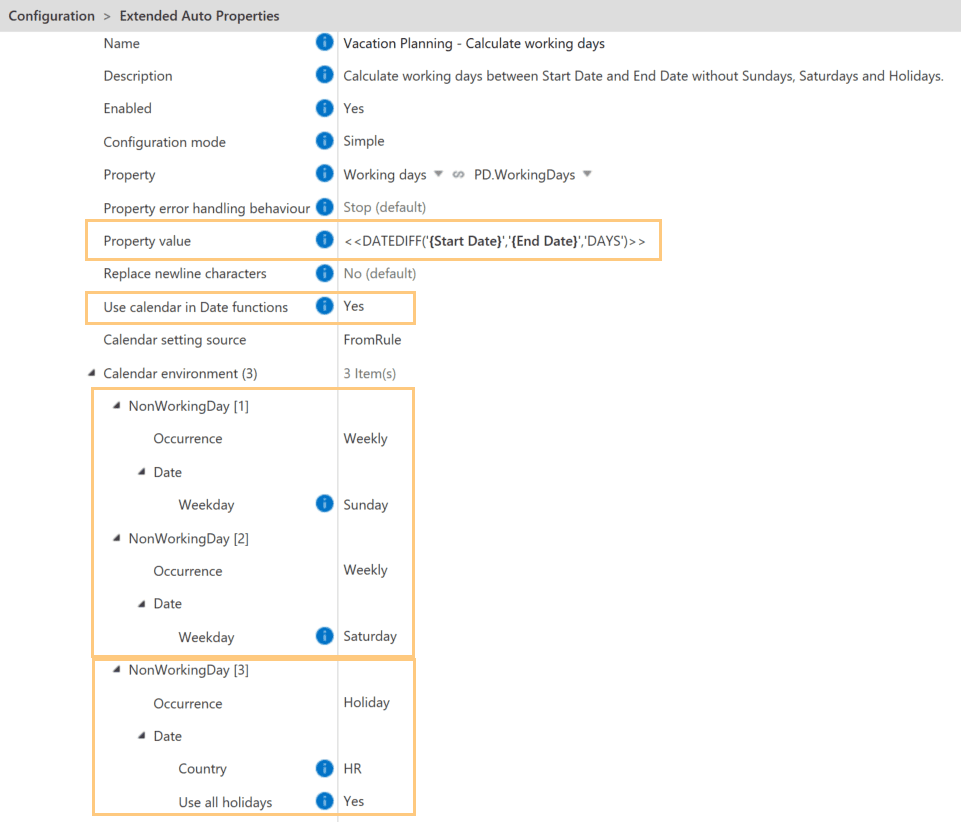
This setup ensures that the “Working Days” property accurately reflects the number of working days during the vacation, excluding weekends and holidays.
Instantly update values with Recalculate properties
Instantly update values with Recalculate properties #
The Extended Auto Properties, Auto Numbering Properties, and Property Builder modules in Extension Kit Core don’t rely on triggers like state changes or user actions. Rules in these modules run automatically when a used property changes, and can be orchestrated if needed.
But what if you update the logic in your rule and want that change to apply to existing objects?
That’s where the Recalculate properties option on the Dashboard comes in.
When and how to use Recalculate properties
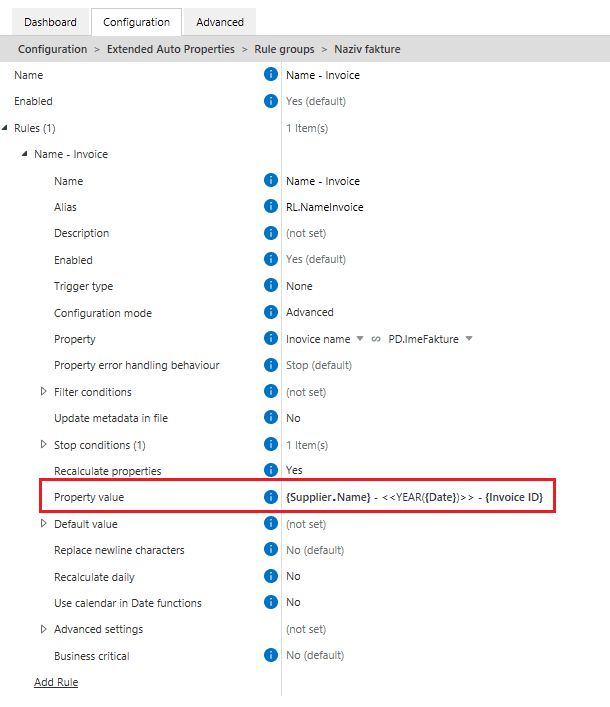
Let’s say you’re using Extended Auto Properties to generate the name of an invoice in this format: Supplier – Year – Invoice ID (Picture 1). The rule creates a name like Supplier_2025_12345.
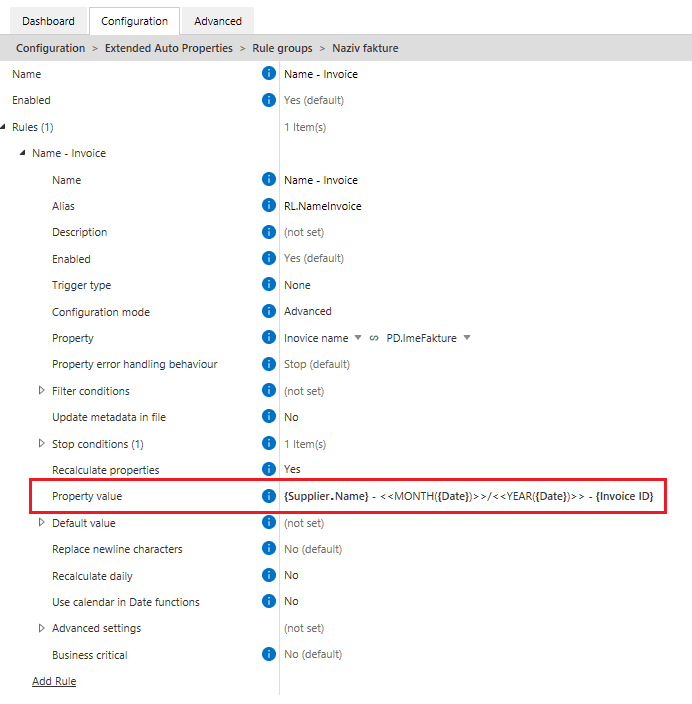
But later, the client asks to modify the naming convention to include the month, so you update the rule with this format: Supplier – Month/Year – Invoice ID (Picture 2).
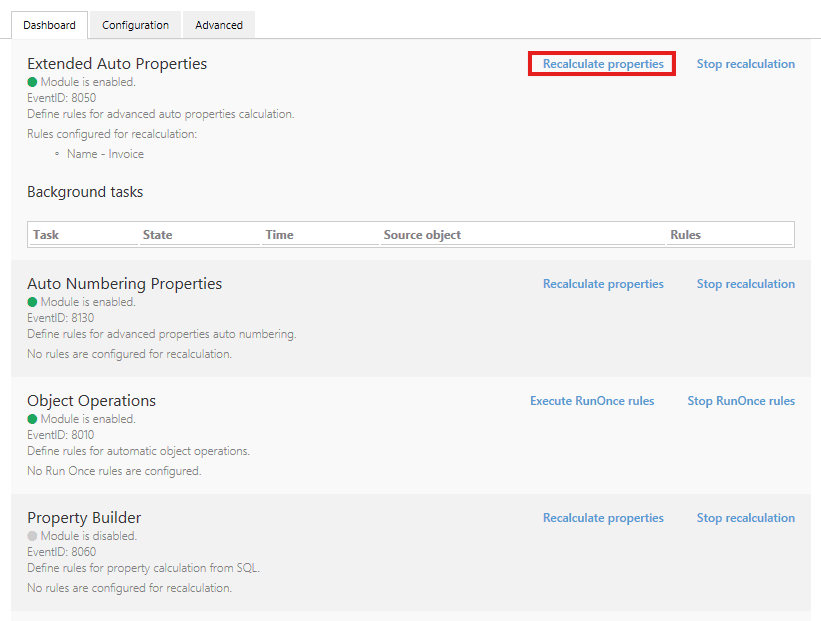
Now, to apply this change to all existing invoices that were named using the old format, go to the Dashboard and click Recalculate properties (Picture 3). All matching documents will be renamed according to the updated rule.
A few things to keep in mind
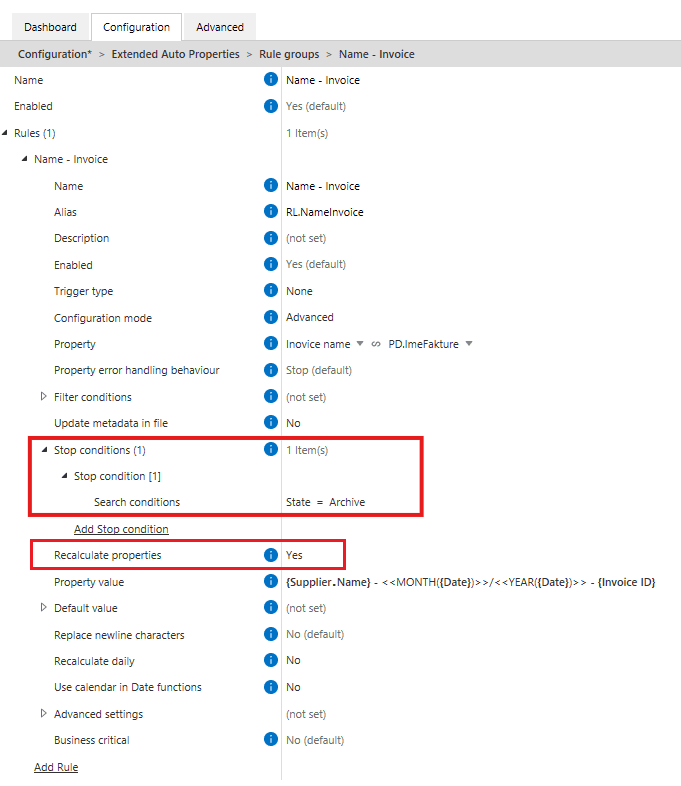
- The Recalculate properties setting in the rule configuration Within the rule configuration, the Recalculate Properties option is enabled by default (Picture 4), meaning property values will be updated when you click Recalculate properties on the Dashboard. If you set it to No, the values won’t be recalculated even if you click the button.
- Stop conditions You can also define Stop conditions to prevent rule execution once certain criteria are met. For example, you may not want the invoice name to change once the invoice is archived. In this case, setting a condition like
State = Archiveensures the rule will not run and the values will not be recalculated for those objects (Picture 4).
Recalculate properties is a quick and reliable way to apply rule changes across your vault, without relying on triggers or manual edits. It keeps your data aligned with your latest configuration in just a few clicks.
How to build error-free nested expressions
How to build error-free nested expressions #
Expressions in the Extended Auto Properties module of Extension Kit Core can range from very simple to complex, especially when combining functions.
This tip shows you how to build expressions step by step and avoid the most common mistakes.
Simple expressions: one value, one function
Expressions based on a single property are straightforward and don’t require quotation marks. Just wrap the property in curly braces.
In Picture 1, the MONTH expression extracts the month from the Start Date property. For example, if Start Date = 1.7.2025, the result is 7.

Expressions with multiple values or properties
When using functions with multiple variables (like DATEADD), make sure to wrap each variable in single quotes, whether it’s a fixed value or a property reference.
In Picture 2, the DATEADD expression calculates a new date by adding 7 days to the Start Date. For example, if Start Date = 1.7.2025, the result is 8.7.2025.

Nested expressions: Build them step by step
When using expressions within expressions — especially with conditional logic — it’s easy to miss a quote or bracket. One small typo can cause the entire expression to fail.
Let’s say:
If the invoice amount is over €10,000, set the payment due in 60 days. Otherwise, set it in 30 days.
To create this, follow a structured approach:
- Start with the Ternary expression parser:
<<'text' operator 'text' ? 'text' : 'text'>> - Insert the
DATEADDexpressions. To make sure quotes are in place, carefully select the word “text” and replace it with the new expression:<<'text' operator 'text' ? '<<DATEADD('date','value','units')>>' : '<<DATEADD('date','value','units')>>'>> - Insert actual values and properties, keeping the quotes:
<<'{Amount Due}' < '10000' ? '<<DATEADD('{Start Date}','30','DAYS')>>' : '<<DATEADD('{Start Date}','60','DAYS')>>'>>
Bonus tip: Use the Expression Parsers section
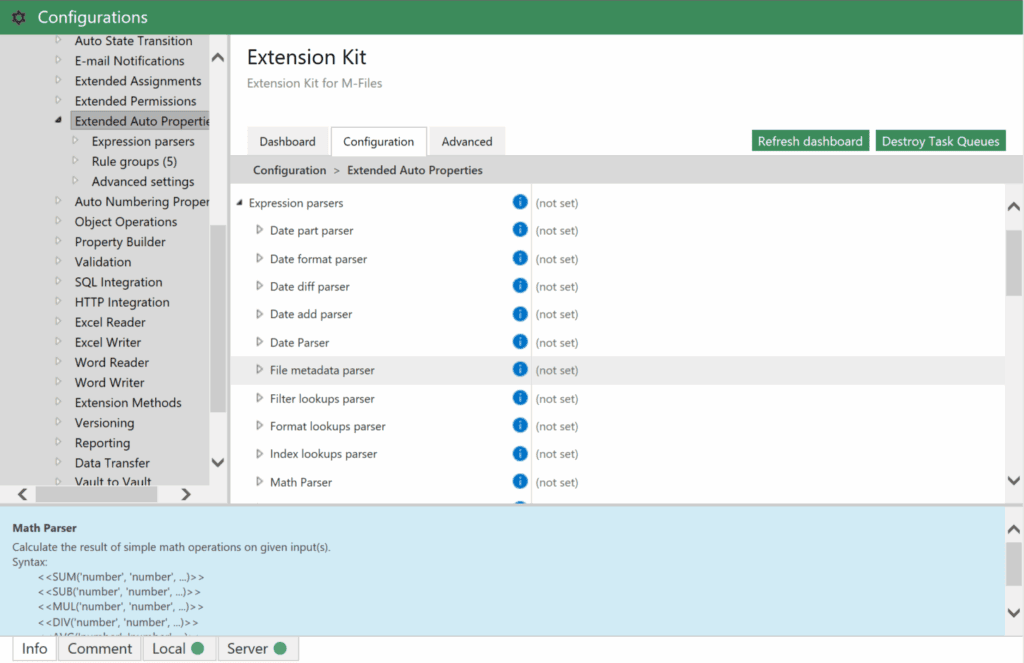
The Expression parsers section in the Extended Auto Properties module contains all available parsers and their syntax (Picture 3). Use it as a reference to copy expressions until you’re familiar with them.
Nesting expressions in Extended Auto Properties
Nesting expressions in Extended Auto Properties #
We’re diving into a useful feature within the Extended Auto Properties module: nesting expressions. Nesting expressions allows you to simplify processes by reducing the need for additional properties, rules, or actions, making your configurations cleaner and more efficient.
Scenario
Consider a customer who needs to create a Case object with a name that combines the Address and City fields. The challenge arises when the external system receiving the Case object has a name field limited to 50 characters. Often, the concatenated string exceeds this limit, requiring you to extract the first 50 characters from the combined Address and City.
Solution
Instead of creating multiple properties or rules, you can achieve the desired outcome in a single step by nesting expressions within the Extended Auto Properties module.
For example, let’s say you have the following fields:
- Address: 123 Main St
- City: Springfield
You need to create a property that combines these fields but ensures the final result does not exceed 50 characters. Here’s how to do it:
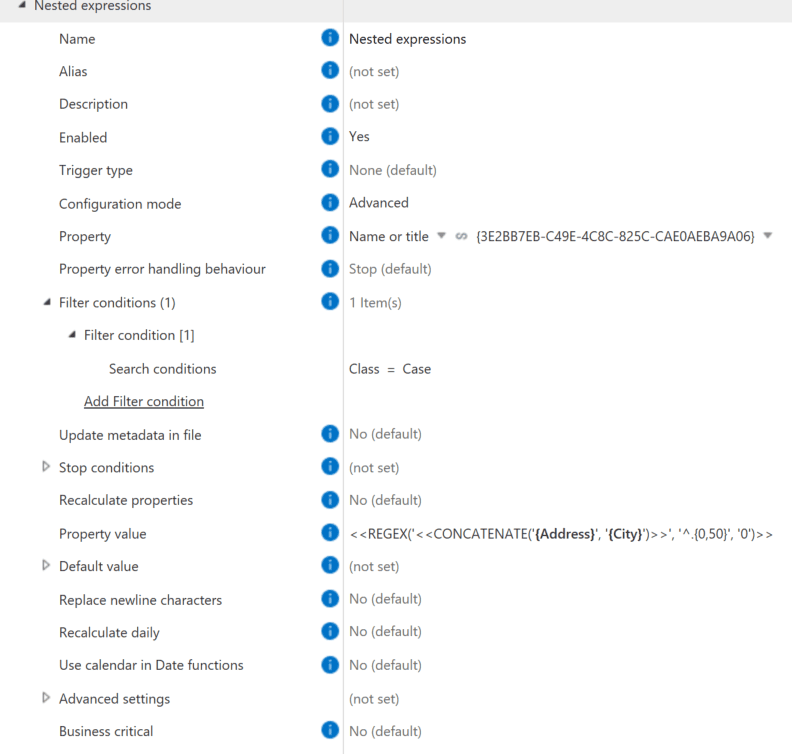
- In the Extended Auto Properties module, configure a rule to fill the Name or title property on the class Case with concatenated Address and City fields, truncated to the first 50 characters.
- Enter the following expression as the property value:
<<REGEX('<<CONCATENATE('{Address}','{City}')>>', '^.{0,50}', '0')>>
And here’s how this configuration looks like in Extension Kit Core (Picture 1):
Using Expression Type in Extended Auto Properties
Using Expression Type in Extended Auto Properties #
When configuring property values using the Extended Auto Properties module, you can make use both of any of our parser expressions and regular M-Files expressions.
When doing that, adjust the Expression Type setting to further control expression capabilities and optimize expression expansion performance.
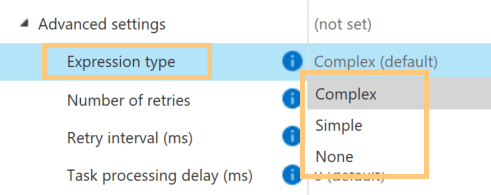
You can find the Expression Type setting under Advanced Settings when a rule is configured in the advanced configuration mode. Each option offers specific benefits depending on your expression needs. Here are the options:
- Complex: Choose this option if your expression uses advanced placeholder editor functionality, such as transitive referencing, properties from the object’s history, or keywords other than ObjID and ObjVer.
- Simple: This option improves performance when your expression involves only top-level properties and uses keywords like ObjID or ObjVer.
- None: Use this option to improve performance further when the expression contains only static values and no properties or placeholders.
Replacing elements in Object Lookup properties
Replacing elements in Object Lookup properties #
Situation
There are many use cases where an object lookup needs to stay in sync with other properties. For example:
Employees create OT Hour Logging Events (HLEs) and select the related project. Once an HLE is created, the employee should automatically appear in the Team Members property on the corresponding Project object.
At first glance, this looks simple to configure with a Property Operation rule that appends the employee from the HLE to the Team Members property on the Project.
But here’s the problem: If a user makes a mistake (e.g., selects the wrong employee), the wrong person gets added to the Project Team. Fixing this by removing and replacing the employee would normally require multiple rules.
Solution
Instead of juggling multiple rules, you can configure it with just one rule:
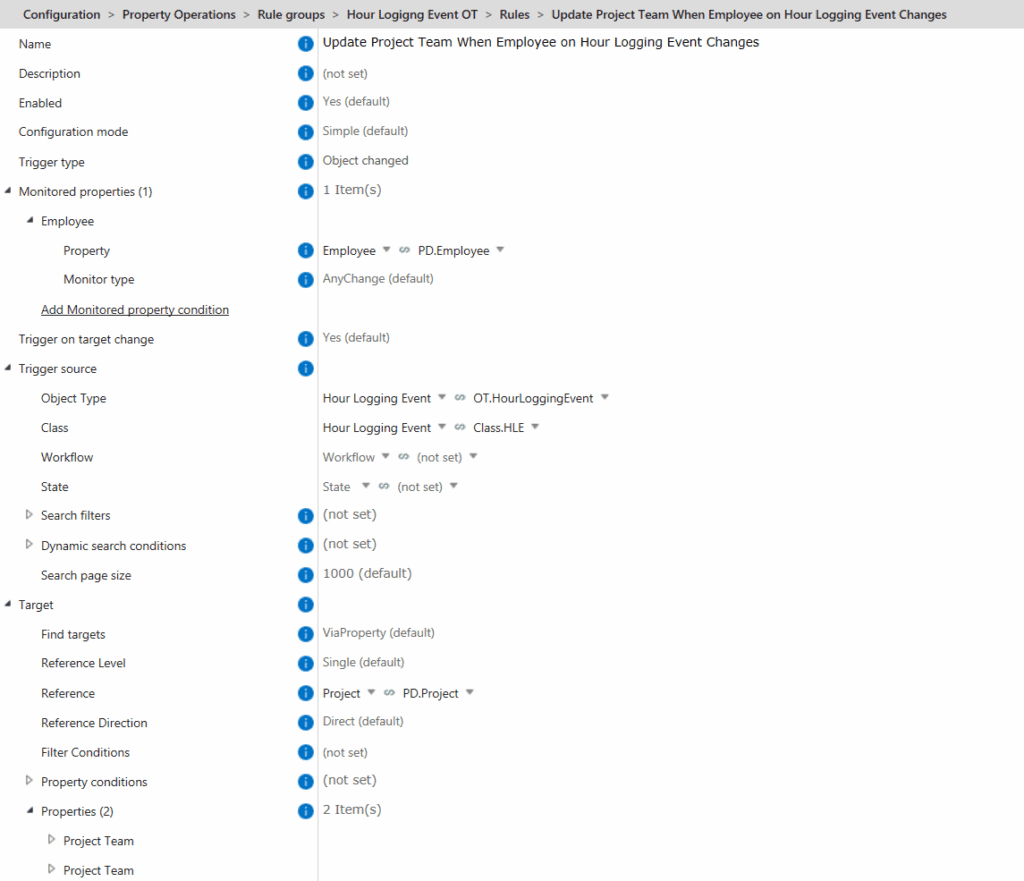
- A change to the Employee property on the Hour Logging Event triggers a Property Operation rule that updates the Project Team property (Picture 1).
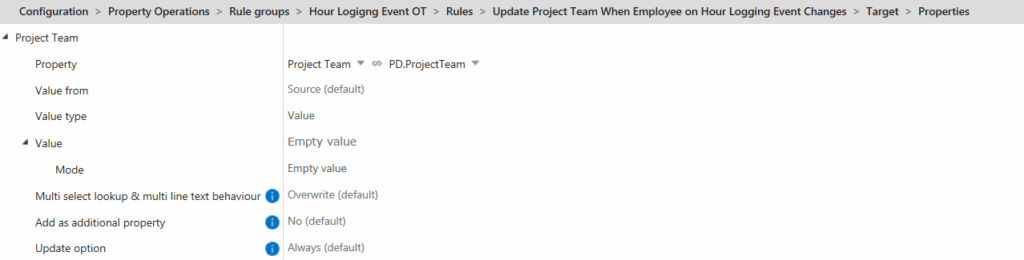
- This rule first clears the Project Team property (Picture 2).
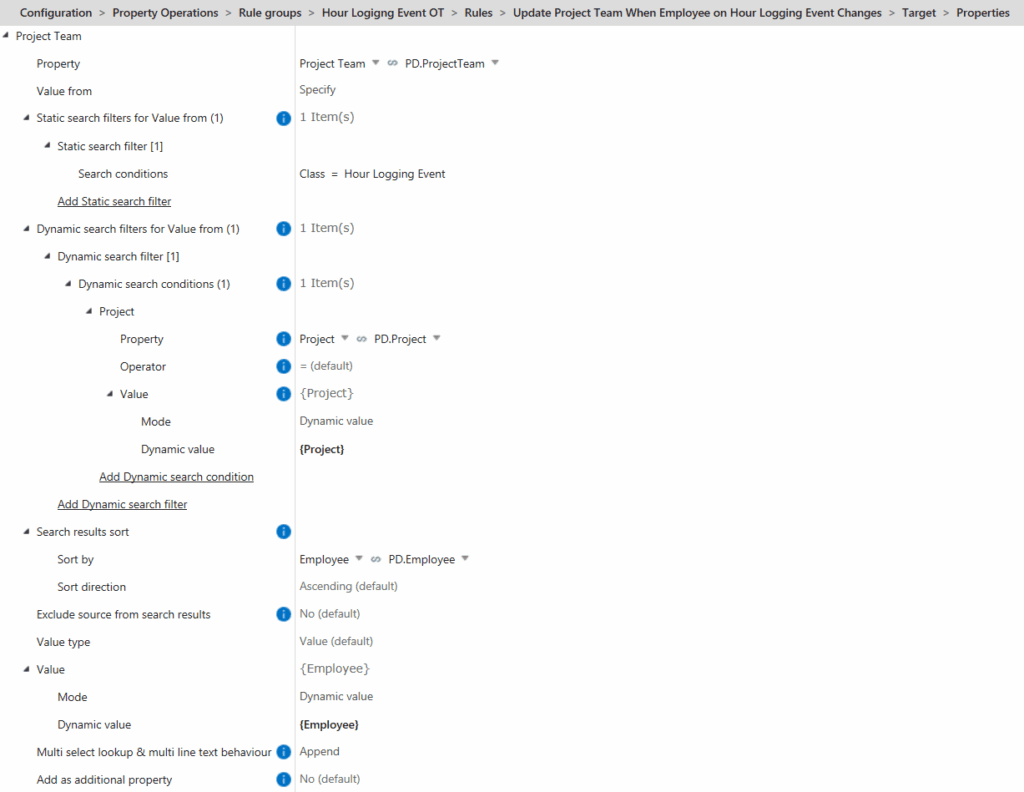
- Then, it searches all Hour Logging Events for that project and re-adds the employees from scratch (Picture 3).
This way, the Project Team is always accurate and up to date, resistant to user errors, and maintained with just a single rule.
Property Operations vs Property Calculations
Property Operations vs Property Calculations #
When should you use Property Operations, and when Property Calculations? Both modules support calculations, but they’re designed for different scenarios. Here’s how to choose the right one.
Property Operations
What it is:
Property Operations lets you set property values based on other properties retrieved via search, reference, or from the source object. Values can be copied directly or calculated using built-in functions for text, numbers, lookup properties, dates, and regex extraction.
When to use it:
Use Property Operations when working with a fixed set of known properties. For example, you might want to calculate a discounted price by combining the original price and a discount percentage stored in another property. This module is ideal for copying values or performing calculations on known variables.
Example:
This configuration uses three known parameters: PD Discount, PD Price, and the constant 0.01, to convert 20% into 0.02. (Picture 1)

Property Calculations
What it is:
Property Calculations enables calculations based on referenced objects in a parent-child hierarchy. It collects values from child objects and applies calculations on the parent.
When to use it:
Use Property Calculations when calculating values from multiple related objects, where the number of objects varies. This module fetches all child objects related to a parent, applies functions like count or sum, and writes the result back to the parent property.
Example:
The configuration below counts all Task objects linked to a Project and writes the result to the “Opened Task” property. (Picture 2)

Conclusion
- Use Property Operations for copying values or calculations involving known, fixed properties.
- Use Property Calculations for calculations across multiple related objects where the number of items can vary.
Creating M-Files objects from XML files
Creating M-Files objects from XML files #
At Unitfly, we continuously respond to customer needs and evolving market requirements.
As eInvoicing becomes mandatory across EU countries, the need for structured XML processing is rapidly expanding.
That is why we developed the XML Processing module in Extension Kit Core — a practical, configurable solution fully integrated inside M-Files.
What can the XML Processing module do?
The XML Processing module allows you to manipulate existing XML files directly within M-Files.
With this module, you can:
- Remove existing elements from XML structures
- Insert new elements populated with values from M-Files object properties
- Extract data from XML files
In this tip, we will focus on Extract — specifically, creating objects in M-Files from an XML file.
Example use case
Imagine you receive an XML export of employees from an HR system (Picture 1).
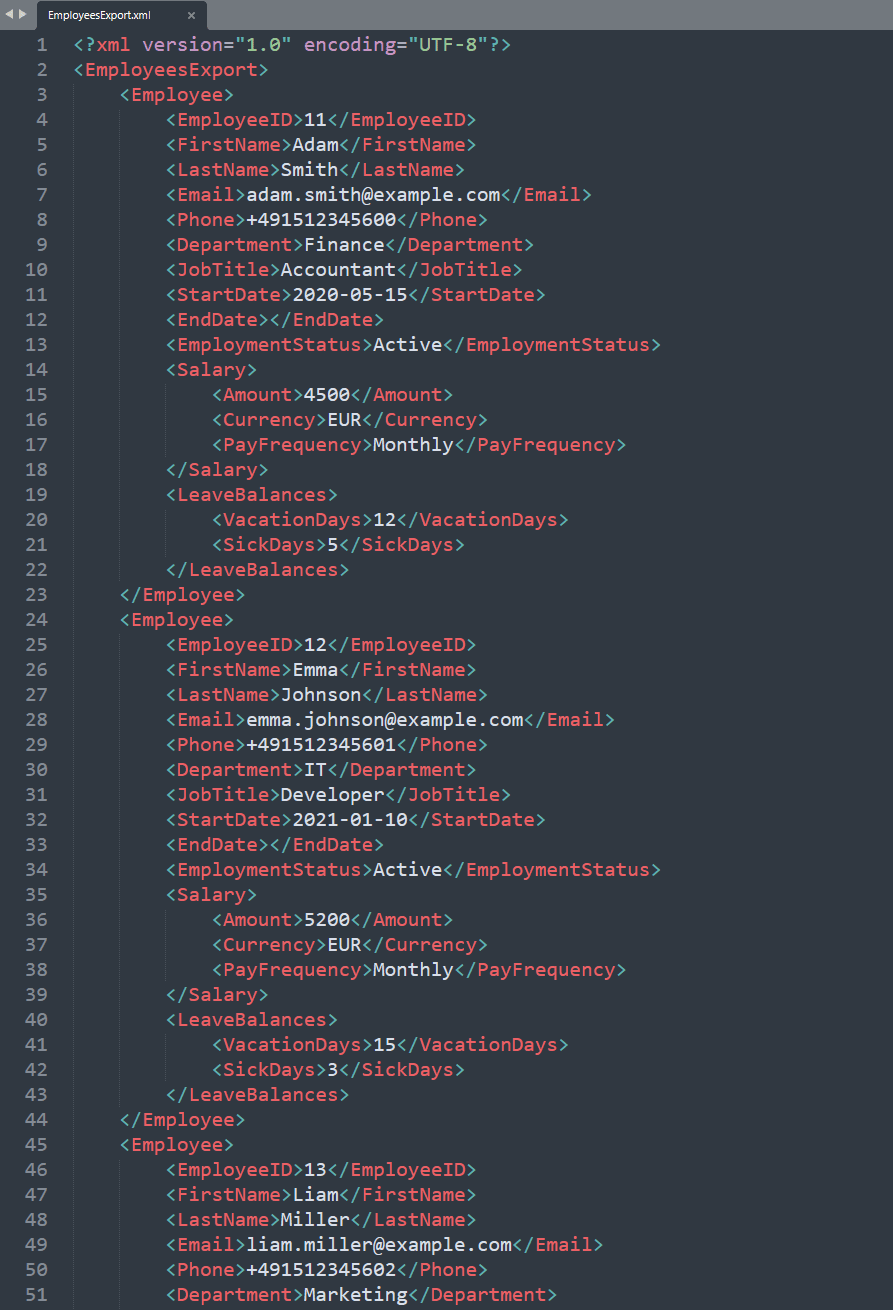
Your goal is to extract that data into M-Files object properties. Within the XML Processing module, you have the option to:
- Set properties and files directly on the source object, or
- Create new objects based on the XML structure (Picture 2)
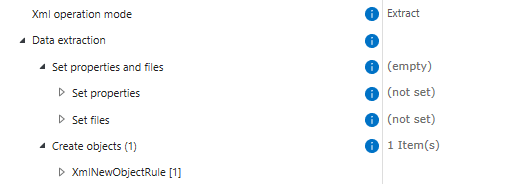
Object creation using XmlNewObjectRule
In a scenario where we want to create a new object, we configure an XmlNewObjectRule that:
- Reads the XML file
- Creates a new Employee object
- Maps the following properties using XPath expressions: Employee ID, First Name, Last Name, Email, Mobile Number (Picture 3).
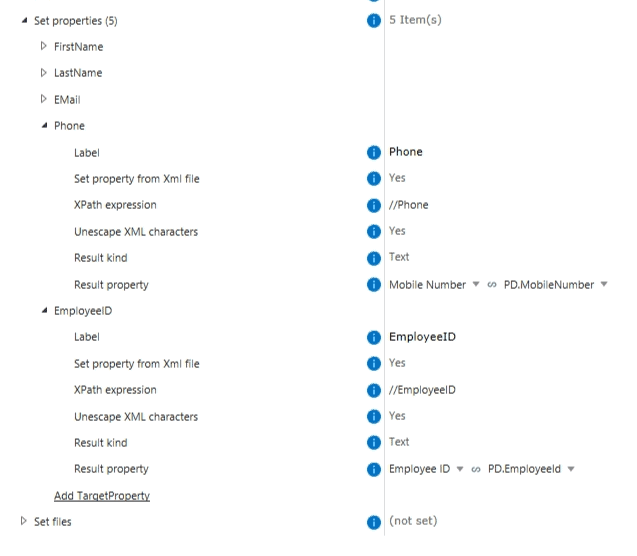
Once the rule is triggered, Extension Kit Core parses the XML structure and automatically creates Employee objects based on the defined mappings (Picture 4).
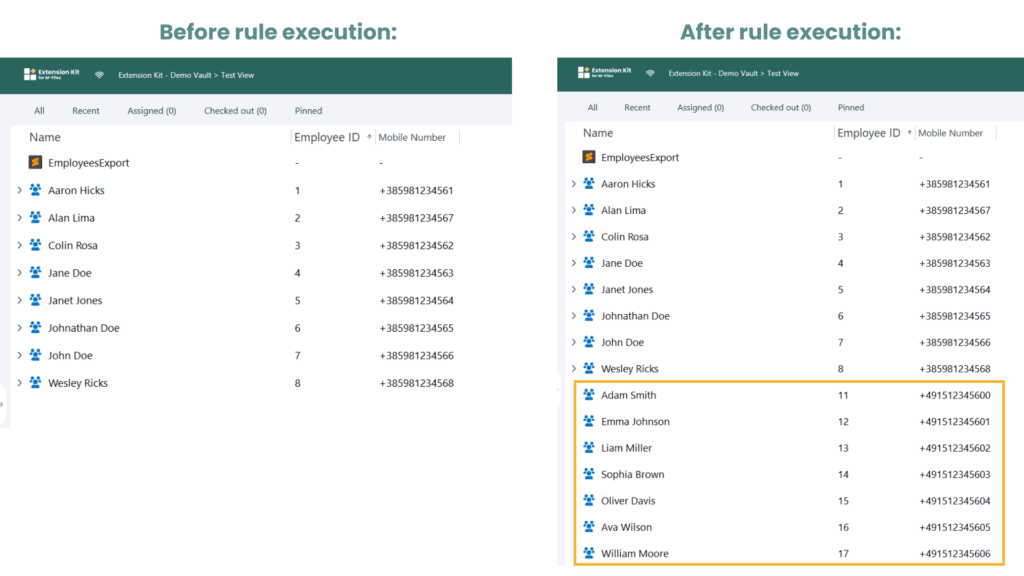
As a result, structured employee data from an external XML file is transformed into fully usable M-Files objects automatically and without coding.
Writing files into XML
Writing files into XML #
After previously covering Extracting data from XML, we now focus on writing into XML — an increasingly important capability as structured data formats continue to gain traction.
Why this matters
Across Europe, there is a clear shift toward structured XML-based data exchange, especially in areas like eInvoicing, integrations, and regulatory reporting.
Instead of working with unstructured files (e.g. PDFs), systems are increasingly expected to read, modify, and generate structured XML documents as part of automated workflows.
This includes scenarios such as:
- Adding or removing elements from existing XML files
- Updating values dynamically based on metadata
- Combining multiple sources into a single structured output
XML Processing in EK
To support these evolving requirements, the XML Processing module in Extension Kit Core now enables:
- Automatic modification of existing XML files
- Insertion and removal of elements
- Updating XML content based on M-Files object data
All of this can be configured directly in M-Files — no custom development required.
Example use case: Invoices
Let’s look at a simplified example of inserting a file into an Invoice XML.
Note: This example is intentionally minimal to demonstrate the core concept, while real-world invoice XML structures are more complex.
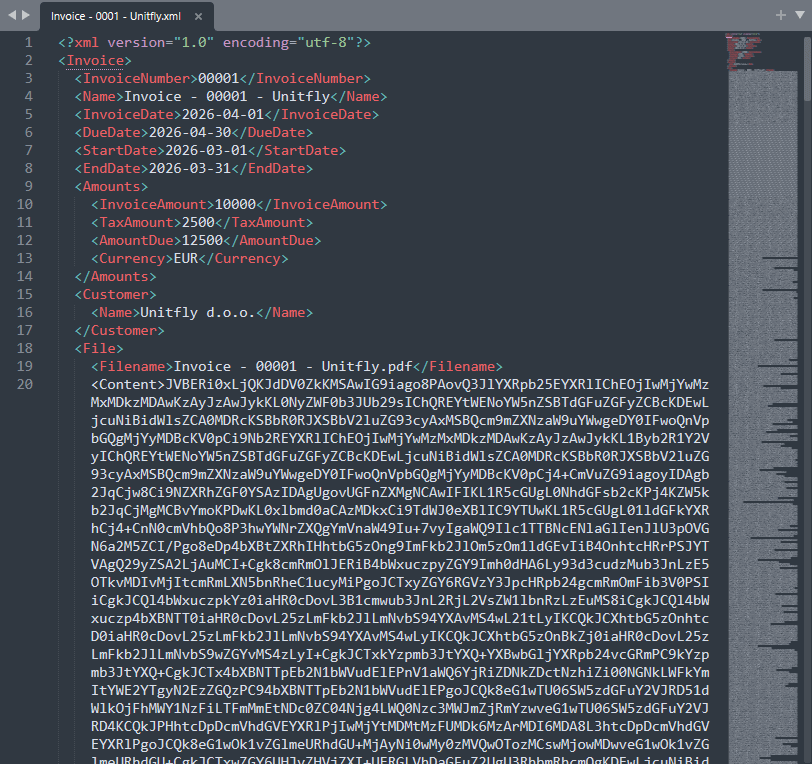
Suppose you have an Invoice object in M-Files with:
- A PDF of the invoice
- An XML with invoice details (Picture 1)
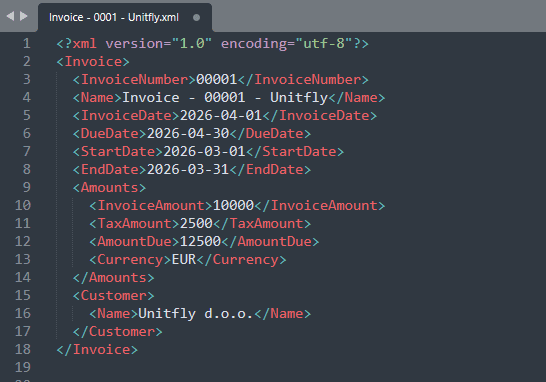
Goal: Insert the PDF into the XML so it appears like this:
<File>
<Filename>Invoice - 00001 - Unitfly.pdf</Filename> <Content>BASE64ENCODED_DATA</Content>
</File>
Note: BASE64ENCODED_DATA represents the PDF content encoded in Base64.
Configuration
We’ll insert three elements into the XML, each building on the previous one:
1. Insert empty <File> tag (Picture 2):
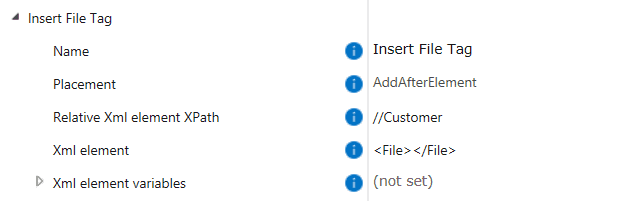
Resulting XML:
<File></File>2. Insert filename (Picture 3):
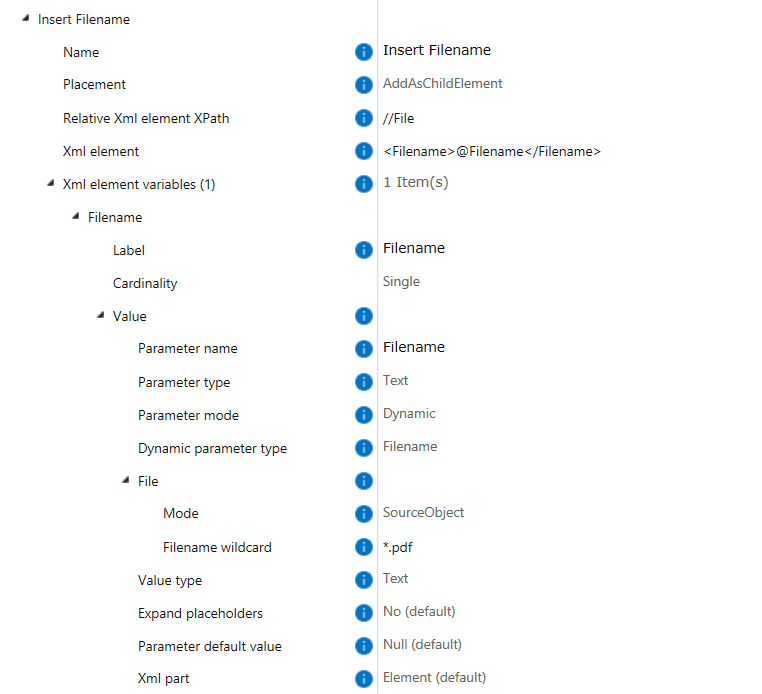
Resulting XML:
<File>
	<Filename>Invoice - 00001 - Unitfly.pdf</Filename>
</File>
3. Insert file content in Base64 (Picture 4):
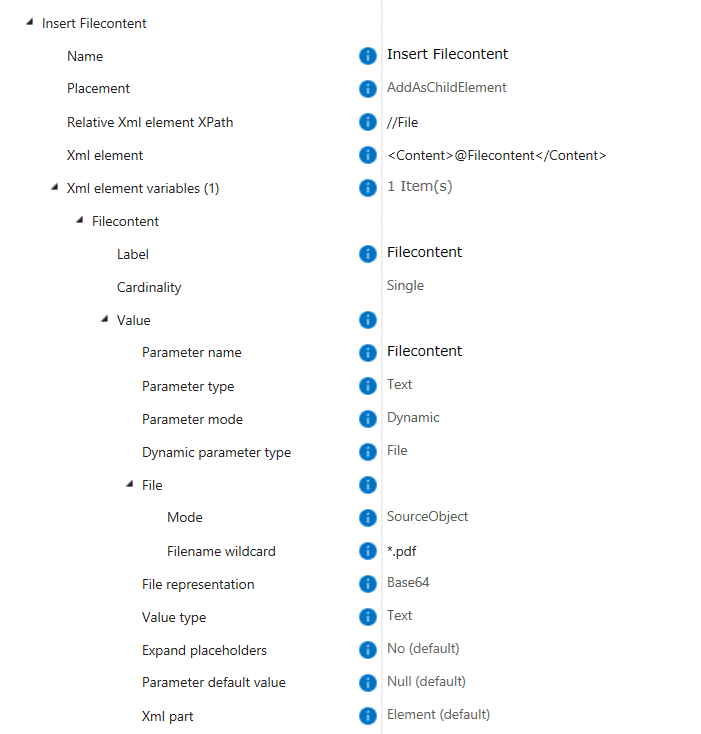
Resulting XML:
<File>
	<Filename>Invoice - 00001 - Unitfly.pdf</Filename>
	<Content>BASE64ENCODED_DATA</Content>
</File>
Key configuration steps
To make this work, the following features are essential:
- XML operation mode: Write Select this mode to modify XML files instead of reading them.
- File action: AddElement Defines that we want to insert new XML elements into an existing file.
- Relative XML element XPath Specifies where in the XML to insert the new element. For example:
//Customer→ insert after the<Customer>node- Insertions can be as a child, before, or after the target element
- XML element Defines the XML body of the element being added, e.g.,
<File></File>. - Sequential insertion Elements are added step by step (empty tag → filename → content) to build the XML correctly.
Result
After triggering the rule, the XML is automatically updated with the document name and Base64 file content (Picture 5).
Note: Future updates will allow writing data from across the entire vault, e.g., generating an XML with all employee data automatically.
Automatically populate employee details from M-Files user accounts
Automatically populate employee details from M-Files user accounts #
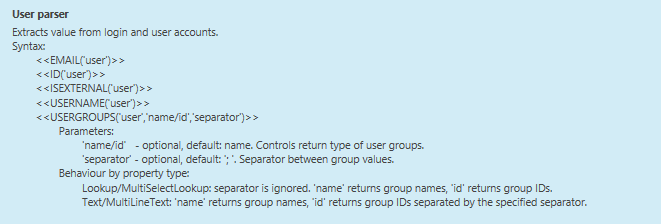
The Extended Auto Properties module in Extension Kit Core offers a variety of macros for property concatenation expressions. These macros let you work with text, dates, numbers, and system information, making it easy to automate updates across your vault.
Among these, the User Parser macro set (Picture 1) allows you to extract information from M-Files login and user accounts. This includes details such as:
- Email address
- User ID
- Username
- External user status
- User groups
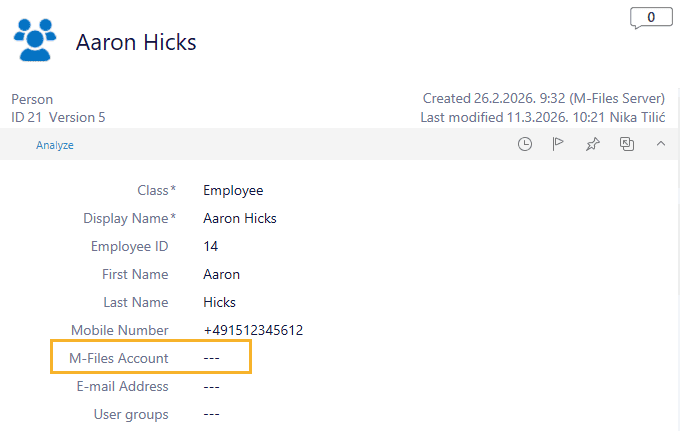
In this tip, we’ll show how to use the EMAIL and USERGROUPS macros to automatically populate Employee properties from an M-Files Account.
Use case
When an Employee object is linked to an M-Files Account (Picture 2), we want the system to automatically fill in:
- E-mail address
- User groups associated with that user
Configuration
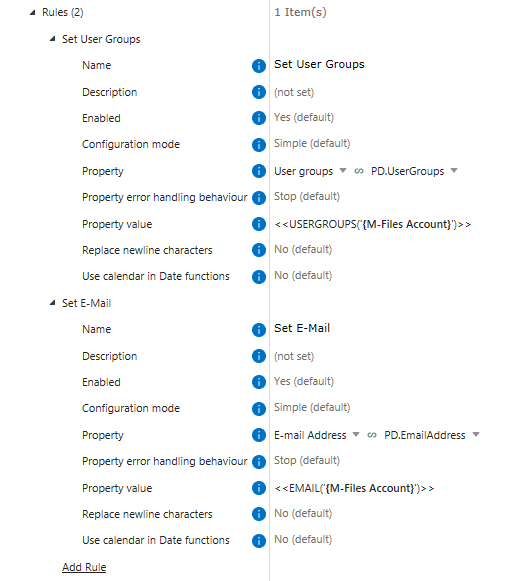
Create a simple rule in Extended Auto Properties that reads the M-Files Account property on the Employee object and retrieves the E-mail address and all associated User groups (Picture 3).
Result
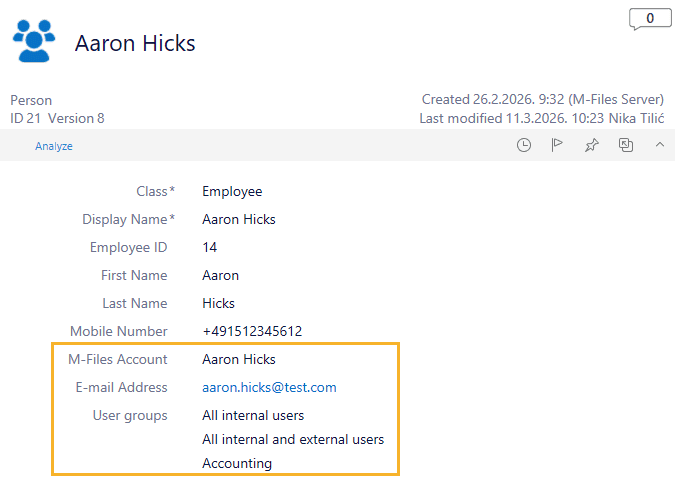
After the M-Files Account is set on the Employee, the Email address and User groups properties are automatically populated (Picture 4).
This ensures employee metadata stays consistent with the user account and eliminates manual updates.